 Photo: Red Circle Authors Limited
A
sk any Japanese publishing executives or well-known contemporary Japanese author to guess what Yukio Mishima’s favourite food was, and you will invariably receive the same answer: steak. This is because, alongside being a highly prolific author, Mishima was also a body builder. Some may go on to comment on the thinness of his legs relative to his highly developed upper body, arguing this “ridiculous” physical imbalance mirrors his “exaggerated” and “bourgeois” lifestyle. Very few will cite chicken or rooster as his culinary preference.  Yukio Mishima weighs training in his 30s. Source: Wikipedia and 『アサヒグラフ』 1955年11月9日号.
This traditional chicken restaurant, still owned and run by the same family, is located in Shimbashi, a lively area, known for, amongst other things, the Shimbashi Geisha. Not far from an impressive-looking black 1940s steam train commemorating Japan’s first train line.
The new line, launched in 1872, running between Shimbashi and Yokohama, cut the travel time between Tokyo and Yokohama and its important port from 10 hours to 55 minutes, and was a major catalyst in Japan’s modernisation and rapid urbanisation. The steam train landmark, a popular meeting point, is much better known than the location of Mishima’s last supper.
 Steam train located in Shimbashi Tokyo. Photo: Red Circle Authors Limited
Mishima, a regular at the restaurant, apparently hoped his ultimately unsuccessful coup, which took place at the Japan Ground Self-Defense Force’s Eastern Corps Headquarters in Ichigaya, might nudge Japan in a new direction to the right, away from Japan’s postwar U.S. imposed constitution. Something he hoped would enhance the role and power of the emperor, and change the course of Japan’s post-war westernisation.
Mishima made the fateful booking at Suegen, taking room number five on the ground floor, having recently polished off the final instalment of his tetralogy Hojo no Uni (The Sea of Fertility).
The restaurant can be found today in the right-hand corner of what is now the large modern S-Plaza Yayoi building, associated with the long-established small but famous shrine, the Karasumori Jinja, which is renowned for granting its congregants’ wishes, nestled behind it.
In Mishima’s, day the restaurant had eight traditional tatami mat rooms on two floors. The private Japanese-style room Mishima was allocated that night was decorated with imposing calligraphy displaying a famous slogan-like phrase attributed to the 19th-century general Takamori Saigo (1828-1877): “Revere God and Love Mankind”.
 Calligraphy on display at Suigen, Revere God and Love Mankind, read right to left. Photo: Red Circle Authors Limited
When the young proprietress, a local girl, who had recently married the founder’s grandson – her primary school classmate, went to make her customary guest greetings she saw Mishima in a suit sitting on the tatami mat floor with his eyes closed and his four ‘shields’ sitting stiffly, formally with their backs upright. She couldn’t find the courage to say anything. And later that evening, she heard that rather unusually Mishima was pouring the beers for his entourage rather than more typically having drinks poured for him, and he and the Tate no Kai were discussing their favourite actresses.
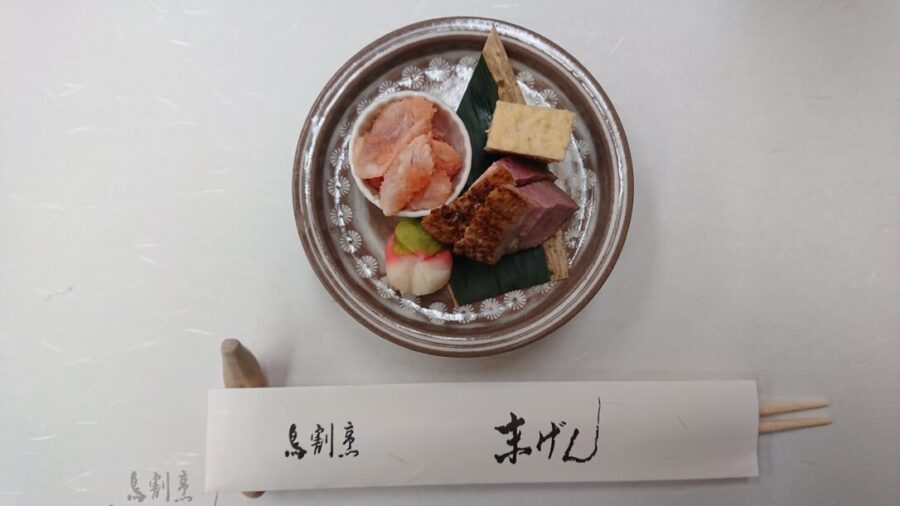
Today, in addition to its reasonably priced lunchtime menu, in the evenings Suegen serves the ‘Wa’ Course priced at 9,350 yen, which includes chicken hotpot, often dubbed Mishima’s last supper, as this is one of the dishes he and his entourage ate on the evening of the 24 November 1970 prior to his death the next day in Ichigaya. The chicken hotpot comes in three servings with a choice of ponzu or a spiced soya sauce.
 Image of Ko Shamo by Beegfood, Wikimedia.
After about two hours, just as Mishima left the restaurant and was standing inside the entrance of the restaurant, tying his shoelaces with his ‘shields’ standing in pairs behind him, the proprietress finally formally greeted Mishima, thanking him for his custom and asking him to come again, to which he replied cryptically, “from beyond”. A response that she found odd and only understood the following day when she heard the news of his dramatic death on television, all of which gave her goosebumps.
Unsurprisingly, the restaurant was bombarded with questions from the Japanese media, but others were left to deal with these enquires and at that time the young proprietress provided no on-the-record commentary on Mishima’s final dinner.
Most evenings the proprietress, now 84, can be found at the restaurant in the kitchen or waiting on tables. Her daughter and daughter-in-law also work in the restaurant. On a recent visit, several tables requested Korean language menus, but there was no sign of any Europeans during a lunchtime or evening visit nor of anyone reading one of Mishima’s 40 or so novels he wrote during the 21 years he was active as a writer.
The proprietress, who somewhat awkwardly confesses to not having read any of Mishima’s works, only sections of them, is actually more of a fan of Takarazuka, the all-female musical theatre group whose main theatre is within walking distance from Suegen and of its star from a bygone age Kuji Asami (1922-1996), than Japanese literature.
 Entrance to Suegen. Photo: Red Circle Authors Limited
From today’s perspective, Mishima’s decisions and his final act, unlike fine prose and calligraphy, have aged like milk and are extremely hard to fathom. In the 1970s they were also considered crazy by some and extraordinary by most, which is why his death was so startling and captured news headlines not just in Japan but also around the world. It is often said that food maketh the mind of man but like so many things about Mishima the man as well as the writer and performer (he acted in films and posed for photographers) it is rather hard to reduce any firm conclusions from his dinner choices, soul food and guilty pleasures.
In his book On Familiar Terms: A Journey Across Cultures, Donald Keene, one of Mishima’s translators, recounts tales of visiting restaurants with him and worrying about his expensive choices and the cost. “Instead of ordering some of each of the different kinds of fish available, he ate nothing except chu toro (the most expensive cut of tuna), as if reluctant to waste his time on lesser varieties of sushi”. Keene also recalls an evening when he and a British journalist ate with the author, when Mishima had ordered five lobster dinners for the three of them, and after they arrived, he ordered a further four. Keene writes that “I should have recognized in this curious extravagance symptoms of special tension, but I did not.”
Whether Mishima’s fate was predictable or not is, of course very hard to say, but a special feature in a magazine published in an issue of Playboy Custom in 1968, two years before Mishima’s death includes astrological predictions about the fate of five popular Japanese writers, Shintaro Ishihara, Kenzaburo Oe, Toshiyuki Kajiyama, Jugo Kuroiwa and Mishima. It predicts a year of good performance but at a high cost for Mishima.
Miss Leila’s astrology, published in the magazine’s spring edition, under the headline Custom Astrology, says the following about Mishima: “A person whose stars are those of an individual blessed with a rare talent with the ability to generate unique literature and aesthetics. Conversely, someone minutely sensitive, even in unexpected domains. Destined to be another good year, but one with risk from a mind and action out of balance. In terms of the financial, there will be major outgoings.” These predictions were made in the year Mishima published Inochi Urimasu (Life for Sale) and the play Waga tomo Hittora (My Friend Hitler) .
Some including Keene have speculated that Mishima was trying to invent or engineer a reason to die. Traditionally, the manner of one’s death is often said to define one’s life in Japan and in a nation sometimes branded ‘the suicide nation” this and Mishima’s exploration of death in art and photography as well as in his writings and his sadomasochistic tendencies has allowed for endless speculation on his motivations and choices. He was 45, at his writing and physical prime, when he died, fortified by a dinner of chilled raw shamo slices, chicken stew with spring onions, rice and beer.
 Raw ingredients for Shamo chicken stew/hotpot served at Suegen. Photo: Red Circle Authors
They were friends and Kawabata mentored Mishima in his early days before the publication of Mishima’s semi-autobiographical novel, Kamen no Kokuhaku (Confessions of a Mask) established Mishima’s literary reputation with its clever word play and vivid imagery. Some believe that if the prize committee decision had been reversed, Mishima was nominated several times and considered a strong candidate, both authors and their works would be remembered very differently from how they are today.
 Chicken stew dish now served at Suegen. Photo: Red Circle Authors Limited
This establishment also has a long history. It was founded in 1919 initially as a tempura restaurant before branching out into soba. Its delicious, but less than opulent cuisine, may not have been sufficient for Mishima to become a regular. However, just like Suegen, it is well worth visiting whether you wish to contemplate this enigmatic and decadent author’s life or death or just enjoy some excellent Japanese fare. It even sells a souvenir t-shirt for 1,500 yen.
After reading out his statement and making his call for insurrection, which was initially greeted with stunned silence by the soldiers present, Mishima’s final words before he committed seppuku, the extremely painful ritual form of disembowelment, were reportedly, “I don’t think they heard me.” Sadly today, Mishima is perhaps better-known for the manner of his death than the supreme quality of his writing. And probably also, but not surprisingly, his interesting culinary choices and his favoured comfort foods.
Nevertheless, they, just like his major works including novels such as Goko no Eiko (The Sailor Who Fell from Grace with the Sea) – one of David Bowie’s all-time favourite books – alongside the restaurants he frequented, are cultural cuts very much worth the indulgence.
© Red Circle Authors Limited
 Yukio Mishima (1925-1970), 1955, Ken Domon. Photo: Wikimedia source: https://unregardoblique.com/2018/02/04/ken-domon-yukio-mishima-1955/